Manual Probe Station
MMPS-SV01 |
 |
| |
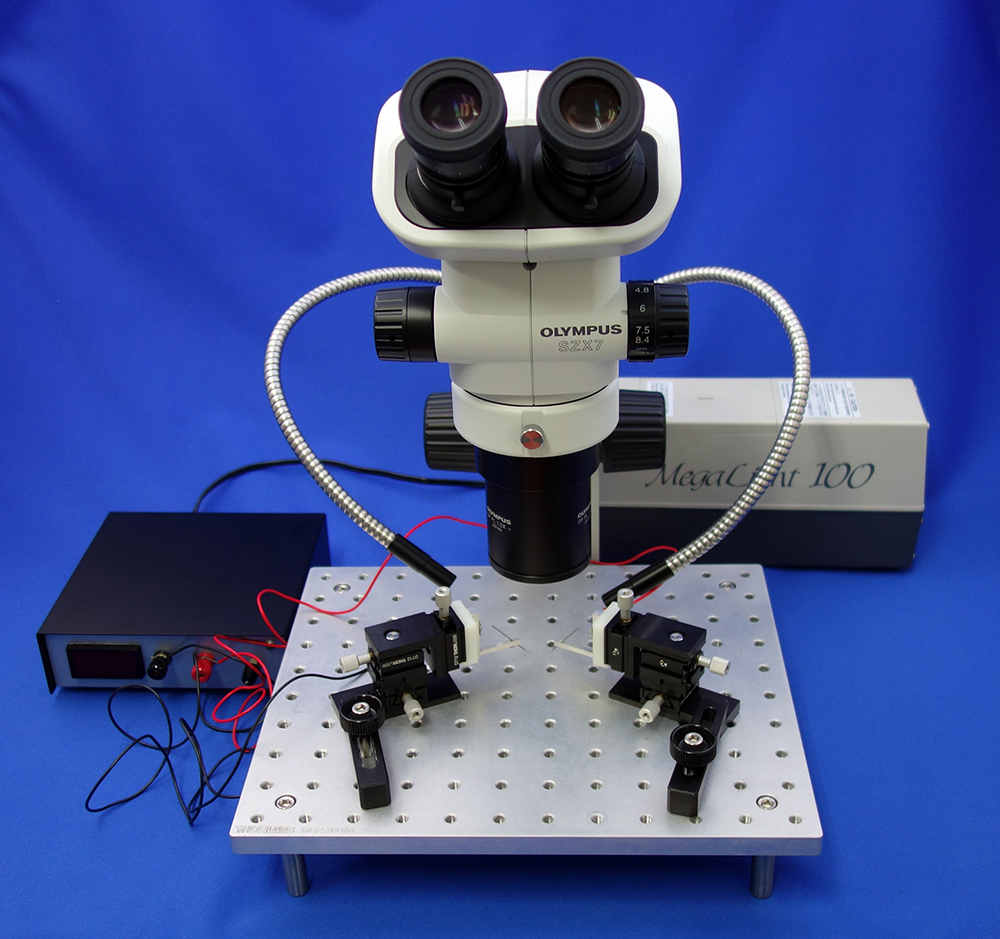
| This manual probe station is designed for evaluating various electrical characteristics of semiconductor devices in research and development as well as manufacturing environments. It is used in particular to obtain basic operating parameters of devices, such as current-voltage (I-V) and capacitance-voltage (C-V) characteristics. The system has a simple configuration without a platen (probe stage), consisting mainly of positioners, probe needles, and a breadboard base. As a result, it is compact and easy to handle, offering the practicality needed for basic evaluation work while minimizing the required installation space. Users can manually position the probe needles and make stable contact with electrode pads formed on silicon wafers or on the surfaces of diced chips. The probe needles are positioned using positioners with travel along the X, Y, and Z axes, enabling accurate contact with the electrode pads. By applying electrical signals with this system, switching characteristics, leakage current, threshold voltage, capacitance changes, and other device properties can be analyzed, making it useful for verifying device operation, failure analysis, and process evaluation. The system is designed as a low-cost, highly versatile probing tool suited to a wide range of applications, from basic semiconductor measurements at educational and academic research institutions to simple inspections on small-scale production lines. |
■Specifications |
| Wafer size |
Up to 2 inches |
| Probe needles |
Material: Tungsten
Tip angle: 5°
Tip radius: 25 μm
|
| Positioners |
XYZ travel range: 12.7 mm
Travel: 350 μm per revolution
Quantity: 2
|
| Base |
Size: 250 mm × 300 mm
Tapped holes: M6, 25 × 25 mm grid
Thickness: 12.7 mm
Material: Aluminum
|
|
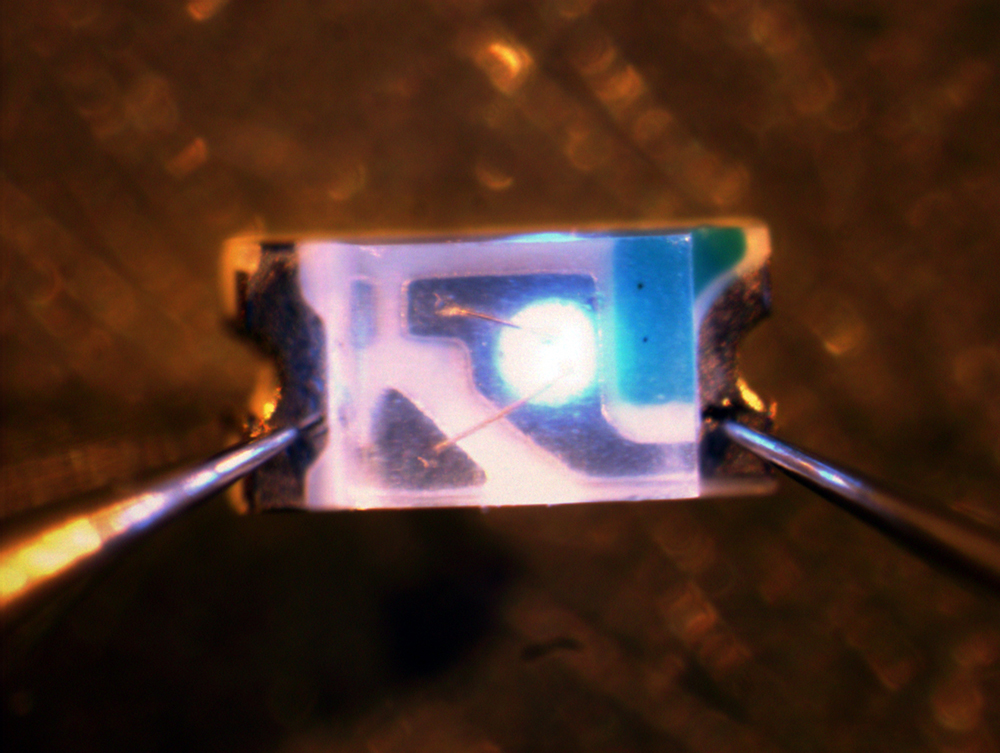
■Microscope Image of an Energized LED Chip (0.5 mm × 1 mm) |
 |
*Specifications and appearance are subject to change without notice for improvement. |
■What Is a Manual Probe Station? |
| A manual probe station is a system used mainly to evaluate the electrical characteristics of semiconductor devices and electronic components. Measurements are performed by manually and precisely positioning probe needles and bringing them into contact with the electrodes of the device under test. Because highly accurate contact with electrode pads formed on wafers or chips is generally required, manual probe stations are equipped with manipulators (positioners) capable of fine adjustment along the X, Y, and Z axes, and a base structure that provides a stable setup. Manual probe stations are characterized by the flexibility to position samples freely and by their low cost, and are widely used for prototype evaluation at universities and research institutions, characterization during product development, failure analysis, and in-process inspection. Another advantage is that they are simpler to operate than automatic probe stations, allowing intuitive operation while observing the sample. In use, combining the probe station with a stereo microscope and illumination enables more accurate positioning of the needle tips. Furthermore, by combining it with measuring instruments such as source meters and parameter analyzers, a wide variety of electrical parameters can be obtained, including I-V characteristics, C-V characteristics, leakage current, and on/off characteristics. |

