Manual Probe Station for External Quantum Efficiency Measurements
MMPS-50EQE |
 |
| |
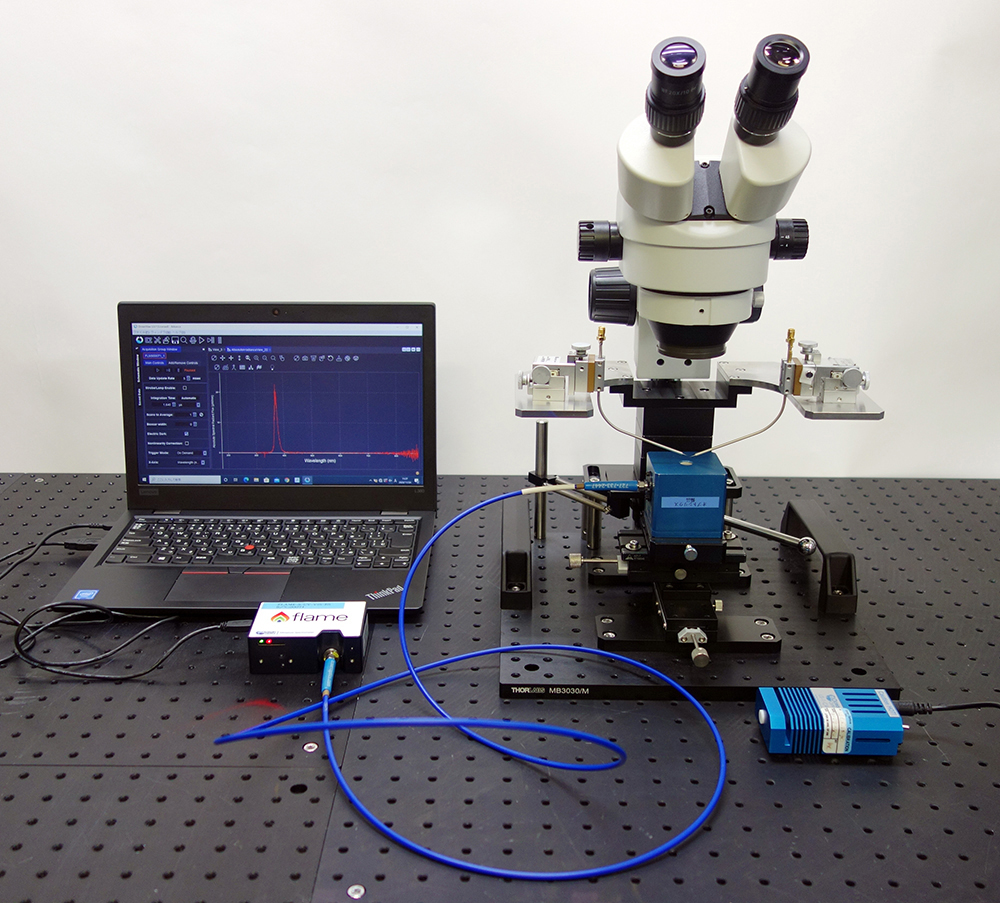
This manual probe station is designed to measure the external quantum efficiency (EQE) of small light-emitting devices such as LEDs. It is optimized for optical characterization of LED devices at the wafer level, providing reliable measurement data for applications ranging from research and development to manufacturing process evaluation.
The system allows probe needles to be positioned precisely on LED electrodes while observing the devices through a microscope at high magnification. Current is applied to produce light emission, and the forward emission (2π solid angle) from the back side of the sample is efficiently collected by an integrating sphere. A spectrometer quantitatively measures the spectral radiant flux (2π) at each wavelength. The photon flux is calculated from the acquired spectral data and combined with the applied current to determine the external quantum efficiency. |
■Specifications |
| Sample Size |
Up to 20 mm × 20 mm |
| Probe Needles (Coaxial Probes) |
Material: Tungsten
Tip radius: 12.5 μm
|
| Positioners |
X/Y/Z travel: 10 mm per axis
Travel per rotation: 250 μm per axis
Quantity: 2
|
| X/Y Travel Range |
±25 mm per axis |
| Z Travel Range |
4 mm |
| Stereo Microscope |
Magnification: 10×–65×
Illumination: LED ring light
|
| Integrating Sphere |
Wavelength range: 200 nm–2500 nm
Internal sphere diameter: 38.1 mm
Coating: Spectralon
|
| Base Plate |
Dimensions: 300 mm × 300 mm |
|
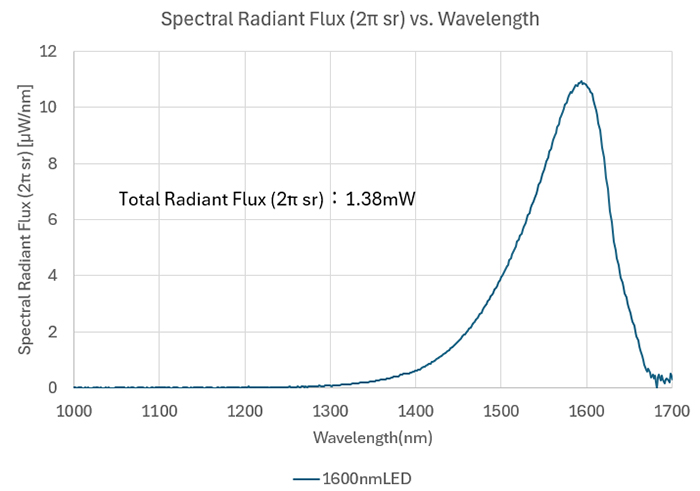
■Spectral Radiant Flux (2π) Measurement Data for a Near-Infrared LED |
 |
*Specifications and appearance are subject to change without notice for product improvement.
*Software for calculating external quantum efficiency is not included. |
■What Is External Quantum Efficiency (EQE)? |
|
External quantum efficiency (EQE) in a light-emitting device such as an LED is
the number of photons emitted outside the device divided by the number of injected electrons.
Formula:
EQE = Emitted photon count ÷ Injected electron count = Φphoton / (I / q)
Note: Φphoton: Photon flux emitted outside the device [photons/s]
Note: I: Current [A]
Note: q: Magnitude of the electron charge (1.602 × 10⁻¹⁹ C)
■ Relationship Between EQE and Other Quantum Efficiencies
EQE can be expressed as:
EQE = IQE × LCE
- IQE (Internal Quantum Efficiency): Internal light-emission efficiency, excluding non-radiative recombination
- LCE (Light Extraction Efficiency): Fraction of internally generated light extracted outside the device
■ Importance of EQE
- Enables quantitative evaluation of the emission performance of LEDs, lasers, and other light-emitting devices
- Provides an important metric for light source design and structural optimization
- Separate analysis of IQE and LCE helps identify ways to improve materials and structures
■ Overview of EQE Measurement
- Apply current to the LED to produce light emission
- Measure the emitted light using an integrating sphere, for example over a 2π solid angle
- Acquire the spectral radiant flux at each wavelength using a spectrometer
- Calculate the photon flux from the radiant energy
- Calculate EQE from the electron and photon fluxes
■ Summary
| Item |
Description |
| Definition |
Number of photons emitted outside the device ÷ Number of injected electrons |
| Unit |
Dimensionless (expressed as a percentage) |
| Components |
EQE = IQE × LCE |
| Applications |
Evaluation of light-emitting devices and design and analysis of light extraction efficiency |
|
■Steps for Calculating External Quantum Efficiency from 2π Measurements |
-
Forward Radiant Flux Measured with an Integrating Sphere (2π Solid Angle)
Calculate the photon flux at each wavelength from the spectral radiant flux measured with the integrating sphere (unit: W).
Formula:
Nphoton = ∫ (Φλ × λ) / (h × c) dλ
Note: Φλ is the spectral radiant flux at wavelength λ [W/nm]
-
Correction for Emission in All Directions (Conversion to 4π)
The integrating sphere measures emission over a 2π solid angle in the forward direction. Assuming a Lambertian (isotropic) emission distribution, the total photon flux emitted into all directions is estimated as twice the measured value.
Φtotal ≈ 2 × Φmeasured
-
Calculate the Injected Electron Flux
Calculate the number of injected electrons per second from the current I [A] supplied to the LED.
Nelectron = I / q
Note: q = 1.602 × 10⁻¹⁹ C (magnitude of the electron charge)
-
Calculate External Quantum Efficiency (EQE)
Calculate EQE from the ratio of the total emitted photon flux to the injected electron flux.
EQE = (2 × Nphoton) / Nelectron = (2 × Nphoton × q) / I
|
■What Is Internal Quantum Efficiency (IQE)? |
|
Internal quantum efficiency (IQE) indicates the fraction of carriers (electrons and holes) excited in a semiconductor material
that recombine radiatively and emit photons.
Definition:
IQE = Number of carriers that recombine radiatively / Total number of recombined carriers
A higher IQE indicates higher internal light-conversion efficiency and contributes significantly to the performance of LEDs, lasers, solar cells, and other devices.
IQE is strongly affected by crystal quality, defect density, interface states, and compositional inhomogeneity.
|
■Overview of IQE Measurement Using a Cryostat |
|
Photoluminescence (PL) measurement using a cryostat is a common method for evaluating relative IQE.
Lowering the temperature to around 10 K suppresses non-radiative recombination, so that nearly all recombination is observed as a radiative process.
The PL intensity at this temperature is used as a reference representing the ideal maximum emission and compared with the room-temperature PL intensity to evaluate IQE.
Approximate formula for IQE:
IQE300K = I300K / I10K
where:
I300K: Integrated PL intensity at room temperature
I10K: Integrated PL intensity at 10 K (maximum emission)
This method provides a relative evaluation of the effects of temperature on non-radiative recombination rather than an absolute value.
|
■Relationship Between External Quantum Efficiency (EQE) and Internal Quantum Efficiency (IQE) |
|
External quantum efficiency (EQE) is the ratio of the number of photons emitted outside a device to the number of injected or generated carriers.
Definition:
EQE = Number of photons emitted outside the device / Number of injected electrons
EQE depends on both internal light-emission efficiency and light extraction efficiency (ηout).
Their relationship is expressed as:
EQE = IQE × ηout
Here, ηout is the fraction of photons generated inside the material that actually escape to the outside.
Because extraction efficiency is limited by total internal reflection, absorption, device structure, and other factors, EQE is generally lower than IQE.
|

